
The Future of Medicine with Jeremy Curnock Cook and his vision for BioScience Managers
November 19, 2024
How Data-Driven Innovations Aim to Transform Asthma Care, Orthopedics, and Neurology, All While Keeping Clinicians in Control
From Rothschild to BioScience Managers
In 2003, Jeremy Curnock Cook launched BioScience Managers (BSM) to drive revolutionary changes in healthcare through smart investments in life sciences. From age 23, he started a business involving biology and brought an unparalleled understanding of the life sciences industry. Having previously headed the Biosciences Unit at Rothschild Asset Management, his approach combines a deep respect for scientific rigour with an intense curiosity for innovation, particularly around integrating data to improve patient outcomes.
At the core of BioScience Managers’ strategy is data. For him, medicine is on the cusp of transformation through digital technology, a shift driven data accessibility for clinicians and patients. He likens this to how a stethoscope, developed over 250 years ago, became a ubiquitous tool for data collection in medicine. Today, BSM’s investments focus on enhancing these tools and evolving traditional practices empowering clinicians with real-time data insights. According to him, this is the currency of change that BSM believes will transform healthcare.
BSM has invested in areas that enable continuous monitoring and smart data analytics to achieve this. This has allowed patients and healthcare providers to make more informed decisions, resulting in better health outcomes.
Tackling the Challenges of Asthma in the Bioscience Industry
One of the key areas Jeremy is most passionate about is asthma care. Though asthma treatments have been available for decades, adherence and engagement remain significant challenges. Many patients hesitate to treat their condition proactively, partly because they don’t want to be seen as sick. Recognising this, BSM invested in Adherium, a leader in digital inhaled device adherence that developed a Hailie® Smartinhaler® that reminds patients to stay on their medication schedule and measures their respiratory health in real-time. Access to respiratory data can then inform doctors of the patient’s progress and encourage compliance, making it easier for asthmatics to manage their condition without constant medical intervention.
“Asthma patients need to feel that their treatment works for them, not the other way around,” Jeremy explained. The smart inhaler is part of BSM’s mission to empower patients to control their health while equipping doctors with the data they need to make better-informed decisions.
Tackling the Challenges of Asthma in the Bioscience Industry
One of the key areas Jeremy is most passionate about is asthma care. Though asthma treatments have been available for decades, adherence and engagement remain significant challenges. Many patients hesitate to treat their condition proactively, partly because they don’t want to be seen as sick. Recognising this, BSM invested in Adherium, a leader in digital inhaled device adherence that developed a Hailie® Smartinhaler® that reminds patients to stay on their medication schedule and measures their respiratory health in real-time. Access to respiratory data can then inform doctors of the patient’s progress and encourage compliance, making it easier for asthmatics to manage their condition without constant medical intervention.
“Asthma patients need to feel that their treatment works for them, not the other way around,” Jeremy explained. The smart inhaler is part of BSM’s mission to empower patients to control their health while equipping doctors with the data they need to make better-informed decisions.
Expanding Horizons: Orthopedic Devices and Neurological Treatments
Beyond asthma, BSM’s portfolio includes innovations in orthopedics and neurology, two areas ripe for data-driven transformation. The orthopedic device market, for instance, is moving from static prosthetics to “smart” implants that track the patient’s progress post-surgery. He points to the example of a smart knee that monitors rehabilitation, alerting both patient and physician to any deviations in recovery. This data enables more personalised and timely interventions, significantly improving recovery rates and quality of life.
In neurology, BSM helps address the unique needs of Parkinson’s patients. Traditional medication can have varied effects, and finding the correct dose can be a process of trial and error. By investing in devices that monitor real-time data, BSM allows doctors to fine-tune treatment regimens for individual patients. This innovation reduces guesswork, improving patients’ quality of life through precision and consistency.
Opportunities Ahead: The Evolution of Data-Driven Medicine
Looking to the future, Jeremy envisions a healthcare landscape increasingly shaped digital technology. BSM is particularly focused on advancements in cardiology, where smart stents might one day monitor a patient’s heart rhythm and blood flow. He also sees potential in managing metabolic conditions like diabetes through wearable devices that track blood sugar in real-time, providing data that can automatically adjust insulin dosages.
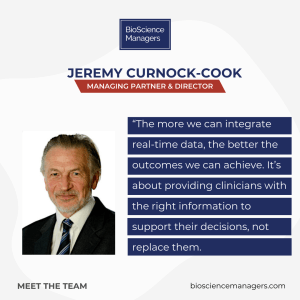
These emerging technologies could redefine the relationship between patients and their health, seeing data as the driver of a new, proactive healthcare system. “The more we can integrate real-time data, the better the outcomes we can achieve. It’s about providing clinicians with the right information to support their decisions, not replace them,” he notes.
AI in Medicine: A Helper, not a leader
As Artificial Intelligence (AI) continues to advance, Jeremy maintains a cautious but optimistic stance on its role in healthcare. He views AI as a support tool that can aid clinicians synthesising large data sets, identifying patterns, and offering insights. However, he firmly believes AI should not overtake human judgment in medical decision-making. “AI should be there to assist, to guide, but not to dictate,” he emphasises. For him, the value of AI lies in its ability to aid clinicians in making more accurate and timely decisions, enhancing rather than replacing their expertise.
His Leadership Views and Commitment to Healthcare Innovation
Despite his demanding schedule, Jeremy’s dedication to his work remains undeterred. His day often starts in the early hours, which is a necessity for managing BioScience Managers’ global operations and connecting with partners across different time zones. He jokingly adds how he drives his wife mad about his seven-day work weeks, as his mind is always occupied with the next project or investment.
Driven a deep-seated curiosity, his approach to leadership and innovation is grounded in a desire to learn constantly. “I’m curious nature,” he shares. “I want to know how things work and how they can work better. The challenge isn’t just finding the next big idea; it’s seeing how we can make a meaningful impact with it.”
This curiosity permeates his leadership, motivating his team to seek answers and push boundaries. For him, effective leadership in a well-functioning team doesn’t always need a single figurehead, “There needs to be some leadership in the organisation that says I can fix this, but most of the time, if you’ve got the right people, they are themselves the leaders and work together, and that leadership just happens.”, he adds.
BioScience Managers is setting a new standard for healthcare investment. With data at the core of its strategy, BSM is pioneering advancements in asthma treatment, orthopaedic devices, and neurological care. As the healthcare sector continues to evolve, BSM is poised to drive these changes, making healthcare more personalised, proactive, and data-driven.
Most importantly, a successful investment is not just about financial returns but also the potential to transform lives. In a world where technology often threatens to overshadow the human touch, Jeremy’s vision for technology as a supportive tool rather than a replacement for clinicians offers a reassuring perspective. Through his unwavering curiosity and commitment to improving patient outcomes, he leads BioScience Managers toward a future where data empowers—not overwhelms—doctors and patients alike.